Before You Take a Reading
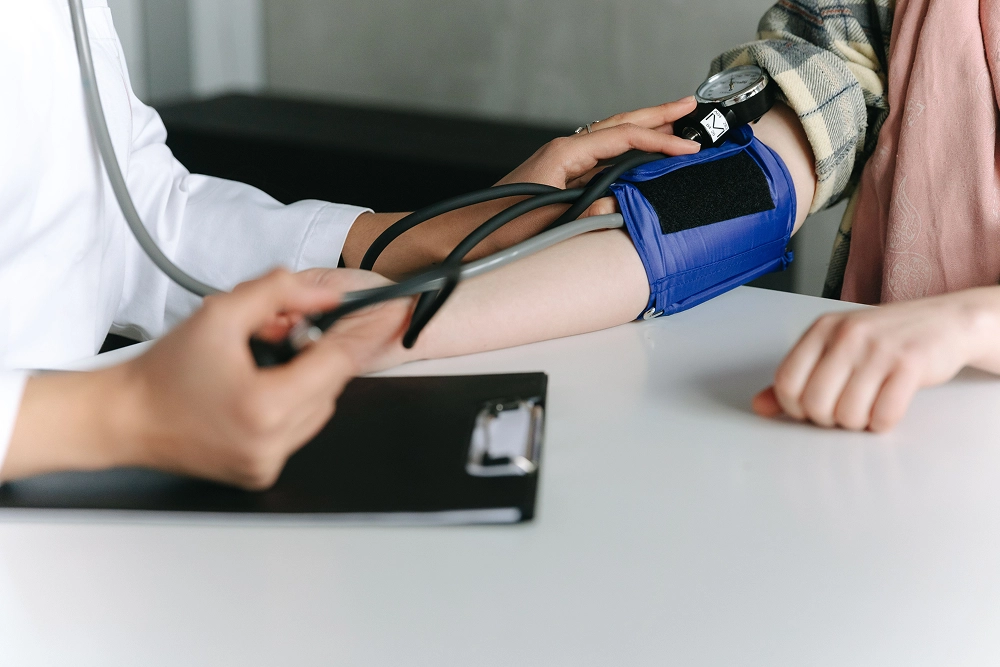
Getting these steps right makes a real difference in your results. Even small mistakes can shift a reading by 5–10 mm Hg — enough to change how a number is interpreted. Follow these steps every time.
- Sit quietly for at least 5 minutes before measuring. Physical activity raises blood pressure temporarily.
- Avoid smoking, exercise, caffeine, and alcohol for at least 30 minutes beforehand.
- Use the bathroom first if needed. A full bladder can raise readings.
- Do not talk during the measurement — conversation can increase systolic blood pressure by 10–15 mm Hg.
- Wait if you are in pain, anxious, or have just received stressful news.
- Measure at the same time each day — ideally morning and evening.
Positioning: How to Sit and Place the Cuff
Body Position
- Sit in a chair with back support. Do not stand or lie down.
- Keep both feet flat on the floor. Do not cross your legs or ankles — this can raise diastolic pressure.
- Rest your arm on a flat surface at heart level. If your arm is too low or too high, the reading will be off.
- Keep your arm relaxed with your palm facing up. Do not support your own arm during the reading.
Cuff Placement
- Use your Onsera-provided device whenever possible. If it is unavailable, we recommend you use an arm cuff that has been tested for accuracy. Wrist and finger devices are less accurate.
- Place the cuff on bare skin, not over clothing.
- Position the cuff about 1 inch above the elbow crease. The cuff should be snug but allow one finger underneath.
- If your arm is large, use a larger cuff. A too-small cuff can make your blood pressure number look higher than it really is.
- Use the same arm every time for consistency. If you have noticed significantly different readings between your two arms, make sure to notify your provider.
Taking the Reading
- Make sure to use your Onsera blood pressure cuff whenever possible. The Onsera cuff will automatically send the results to the Engage app. Your provider will talk about the results with you at your next follow up appointment. Please note, your doctor or nurse practitioner will not look at these numbers until your next visit.
- If you are not using the Onsera cuff, use the manual option in the Engage app to log the reading.
- Follow the measurement directions given by your provider. Usually we ask patients to track their blood pressure twice a day, morning and evening, for a week followed by three-times-per-week measurements, but the specific frequency is personalized to your specific needs.
AHA Blood Pressure Categories
Blood pressure is classified using the framework below, based on the 2025 AHA/ACC guideline. If your systolic (the top number) and diastolic (the bottom number) readings fall in different categories, use the higher one. For instance, a blood pressure of 130/95 is considered stage 2 hypertension as the diastolic reading of 95 places the blood pressure in stage 2, which is higher than the stage 1 hypertension the systolic of 130 places the reading in.
| BP Category |
Systolic (mm Hg) |
|
Diastolic (mm Hg) |
Action |
| Normal |
< 120 |
and |
< 80 |
Goal range |
| Elevated |
120–129 |
and |
< 80 |
Monitor closely |
| Stage 1 Hypertension |
130–139 |
or |
80–89 |
Talk to care team |
| Stage 2 Hypertension |
≥ 140 |
or |
≥ 90 |
Contact care team |
| Hypertensive Urgency or Emergency |
≥ 180 |
or |
≥ 120 |
Seek immediate medical care* (see below for details). |
Seek Urgent or Emergency Care If…
Immediately call 911 and go to the nearest Emergency Department if your blood pressure is 180 or higher systolic (on the top) and/or 120 or higher diastolic (on the bottom) AND you are experiencing any unusual symptoms. Such symptoms may include:
- Severe or sudden headache unlike your usual headaches (if any).
- Chest pain, tightness, or pressure.
- Shortness of breath or sudden difficulty breathing.
- Sudden vision changes, blurring, or loss of vision.
- Slurred speech, facial drooping, arm weakness, or other signs of stroke
- Severe anxiety, confusion, or not acting like yourself.
💡This is called hypertensive emergency and is considered a medical emergency. Do not ignore it or delay seeking care. Your blood pressure is high enough that, combined with your symptoms, your organs may be affected by the high blood pressure right now and you may require immediate medical treatment.
Seek immediate in–person care if your pressure is 180 or higher systolic (on the top) and/or 120 or higher diastolic (on the bottom) and you do NOT have any symptoms.
Rest for a few minutes and retake the reading to confirm. If the repeat reading remains at 180/120 mm Hg or higher, then you are experiencing hypertension urgency. Your blood pressure is high enough to cause immediate harm, but without symptoms it is unlikely to have caused harm yet. Immediate medical care by an in-person PCP, urgent care, or – if no other option is open – an emergency department is needed to confirm your blood pressure reading and immediately adjust your medication to decrease your blood pressure before any damage occurs. Do not ignore it. Rest for a few minutes and retake the reading to confirm. If the repeat reading remains at 180/120 mm Hg or higher, seek same-day in-person medical care. Do not take extra doses of blood pressure medication without professional medical guidance.
💡After the emergent or urgent medical need has been taken care of, remember to notify your Onsera provider about the situation and any changes made to your medications.
Contact Your Care Team If…
Reach Out — Don’t Wait It Out
- Your home readings are consistently at or above the goal set by your provider across multiple days.
- You notice a significant increase from your usual readings.
- Your readings are consistently below 90/60 mm Hg and you feel lightheaded or fatigued.
- You have started a new medication and your blood pressure has changed noticeably beyond what your provider told you to expect.
- You have questions about your device, technique, or how to log your readings.
Low Blood Pressure (Hypotension) Signs
- Systolic below 90 mm Hg or diastolic below 60 mm Hg.
- Dizziness or lightheadedness, especially when standing up quickly.
- Blurred vision, nausea, or unusual fatigue.
- Feeling cold, clammy, or pale.
- These may be medication-related. Contact your care team before adjusting any dose.
This handout is for educational purposes only and does not replace personalized medical advice from your healthcare provider. Always consult your Onsera care team before making changes to your medications or treatment plan.
Reference: Jones DW, et al. 2025 ACC/AHA Guideline for the Prevention, Detection, Evaluation, and Management of High Blood Pressure in Adults. Hypertension. 2025;82:e212–e316. DOI: 10.1161/HYP.0000000000000249